
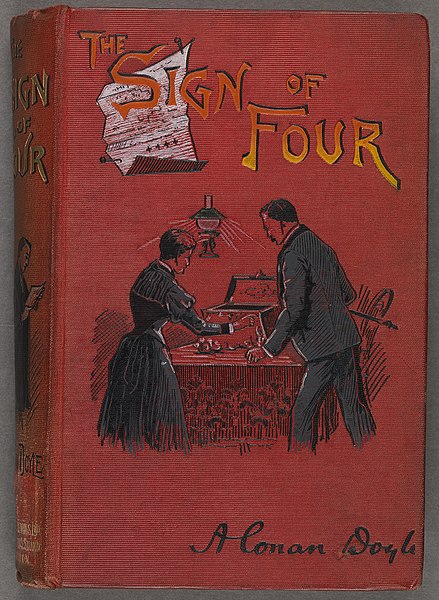
The Sign of Four – Sherlock Holmes #2

The year 1890 was a special time for the readers of Lippincott’s Monthly Magazine. Two legends in the making, Arthur Conan Doyle and Oscar Wilde, agreed to write stories for this American magazine making its British debut. Wilde produced The Picture of Dorian Gray, and Doyle gave us his second Holmes outing, The Sign of the Four (its title now popularly shortened to four words—seems appropriate).

In spite of the decade-and-a-half that has passed since I last read The Sign of Four, much of it came back to me as I was reading. There was hardly a twist or turn I had forgotten, in part due to the incredible Jeremy Brett adaptation that I am sure I watched as many times as I read the book. The lady in distress (Watson’s crush), the brothers Sholto, the amusing Inspector Jones, and “Toby” all returned readily to memory, a strange mix of book and film blended together. My reading experience was a bit worse for being devoid of surprise, but it was pleasant enough to spend time with Holmes and Watson again.

Once again, any fledgling author should take heart in this peculiar novel. Holmes was not at this point a household name; his debut novel had fared badly. Why Doyle was asked to write another is something I still don’t understand, but we can be grateful he was given another chance to iterate on his eccentric character.

He begins the story audaciously with Holmes and his infamous needle. Victorian sensibilities are saved by our narrator Watson, who (in one of the few controversial scenes that has aged well) condemns Holmes’s use of cocaine and admonishes him for putting his mental capacities on the line with repeated drug use. Not long after this, Miss Mary Morstan shows up to Baker Street in search of two friends (don’t we all?). She is a humble governess who has been receiving mysterious messages and gifts in the mail. For John Watson, it’s love at first sight, but first they must solve a string of mysteries, and he must hide his feelings under lock-and-key of professionalism and his lowly station.

What I always liked about The Sign of Four in the past, and which it still deserves credit for, is its sheer variety. Quirky characters, moody landscapes, chase scenes, silly inspectors—it has it all. Doyle also brought back an elaborate, historically framed backstory for his villain, although in a briefer narration than we got in the first novel. Knowing as I do that Doyle had a heart for historical fiction, it’s interesting to see him struggle to let go of this pet subject of his. It works much better here than in Scarlet, as it weaves in the Indian Rebellion of 1857—presumably Doyle’s readers would have been far more familiar with that setting than the American West. As one might imagine, the treatment of ethnic minorities in this book is pretty dated and carries similar sensationalism of dubious accuracy.

While rereading this novel was somewhat of a letdown compared to past readings, I think it is still very worth a first reading, and it is fun to see Doyle’s “Baker Street-verse” really start to come into its own.


8 responses to “The Sign of Four – Sherlock Holmes #2”

  1. Proper comment tomorrow (as its coming up to midnight here & I’m on my way to bed) but I saw this & thought you’d be as interested as I was…
    https://wellcomecollection.org/articles/XN6XsxAAAFk1pmQ7

    Liked by 1 person

    1. Wow, that’s crazy… and puts to rest my assumption of the flabbergasted Victorian reader. 😆
      So was Watson ahead of his time??

      Like

  2. Sounds wild. Everything from India to the American west!

    Liked by 1 person

    1. Doyle sure pulled out all the stops in these two novels!

      Like

  3. I’ll definitely have to read up about Victorian attitudes to drug use. They did seem much more relaxed about the whole thing – or maybe they just misunderstood the long-term implications – than they did regarding sex. They certainly knew about addiction but then maybe they thought only the weak, immoral or foreigner became addicted to such things?

    As I said over @ my place, I found the social implications of Watson’s love – especially as the ‘treasure’ was supposedly worth so much! – more interesting that the attraction itself. I wonder if there was an agreed upon financial bracket that people needed to fit themselves into. But I guess that marriage in that age was much more of a financial transaction than a romantic one?

    I always enjoy the secondary characters in books like this! SO varied and interesting. I wonder if that’s a legacy of Dickens or does it go back further than that. Modern tales seem to be focused very much on the main characters with ‘walk-on’ parts barely fleshed out, so its good to see real characters – like the owner of ‘Toby’ – being a bit more 3 dimensional (plus nice to see Holmes as an animal person).

    Although the Indian Mutiny section was much more reserved than the previous Utah diversion in ‘Scarlet’, I still found it a bit… distracting. I can imagine it was inserted to add a bit of the exotic but, as far as I remember, he does less of this going forward and concentrates much more on the detective elements – here I particularly liked his ‘scene-of-crime’ investigation at the murder site which I thought was very modern. A good outing overall and I’m looking forward to ‘Adventures’ in December.

    Liked by 1 person

    1. “I wonder if there was an agreed upon financial bracket that people needed to fit themselves into. But I guess that marriage in that age was much more of a financial transaction than a romantic one?”

      From what I understand, these would both have been true… people were generally expected to marry within their class, and Watson was especially worried that Mary would view him as an opportunist/gold-digger if he declared his feelings only after the treasure was announced.

      I agree about the Mutiny being distracting… I find the subject pretty interesting but the villain’s account of it goes on for far too long. 😛

      Like

  4. […] we saw in A Study in Scarlet. This is further evidenced by the fact Watson moving out at the end of The Sign of Four caused no issue with Holmes continuing at […]

    Like

  5. […] a bit as I turned the last pages. It’s not as well crafted, in my humble opinion, as The Sign of Four. Besides being quite a slow burn instead of a constant thriller, there are one or two loose threads […]

    Like

Leave a comment

About Me

Hi, I’m Marian—I talk about classics, history, and other books on this blog, as well as on YouTube.

Currently Reading


Recent Posts

ARCHIVES

Newsletter