
Banquo: How goes the night, boy?
Fleance: The moon is down; I have not heard the clock.
Banquo: And she goes down at twelve.
Fleance: I take’t, ’tis later, sir
—Macbeth, Shakespeare
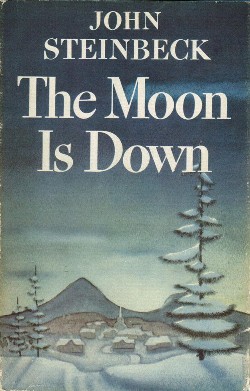
As is often the case, my first book by this famous author was not his most famous work. A bookish friend and Steinbeck fan mentioned this title recently; it’s a little book (about 110 pages), and I was happy to stumble across it at the library. The Moon Is Down was a rallying cry written to strengthen the Allies during WWII, banned in Italy during Mussolini’s reign, and that’s about all I knew about it going in.
My Expectations
I’ve seen enough WWII propaganda from the 40s that I wasn’t expecting a whole lot from this book. The old Sherlock Holmes adaptations (saved by the sheer stage presence of Basil Rathbone), plus numerous other war-themed movies, show how this genre can get heavy-handed at best, melodramatic and off-putting at worst. There was one film in particular I had to watch for British history class—I think it was Went the Day Well? (1942)—which was basically a montage of townspeople killing invading Nazis with shocking viciousness.
I had also previously seen adaptations of The Grapes of Wrath (1940, Henry Fonda) and Of Mice and Men (1992, John Malkovich). Grapes was marred for me by one character giving a very preachy speech at the end. The other story, while a masterpiece, ends with one of the most tragic scenes I’ve encountered in fiction. Would this zest for sermonizing and dramatics manifest itself in The Moon Is Down?
The Story
Scene: A quiet, peace-loving town somewhere in Europe. Elderly Mayor Orden, his wife, and his household await the visit of Colonel Lanser, whose men have just disarmed and overtaken the people. The town’s main industry is coal mining, where the citizens have worked diligently up till now. Lanser insists the work goes on as usual, even though his unwelcome forces are now occupying the place. Orden is trapped in a difficult position. Does he appease the invaders to protect his people—fueling his people’s distrust of him—or does he thwart the colonel as best he can, at the risk of his life and position? How ought he to face these difficult times he had never anticipated?
Men and Women, Soldiers and Mayors…
This story was published almost simultaneously as both a novel (March 1942) and a play (April 1942). As such, it takes place in just a few settings in the town and is largely character driven. I wasn’t expecting subtlety from this kind of story, least of all from Steinbeck, but this novella’s strengths lie in its profound restraint and nuance.
Parallel to the mayor’s plight, we get to know the Nazi characters in depth, especially the colonel. Lanser is not a man without feeling, but he is very self-aware about compartmentalizing his conscience so that he can carry out his orders. The men beneath him grow anxious, then absorbed by their various coping mechanisms. One man buries himself in technical work, forgetting everything human (and inhumane) about his job. Another dreams of women and pursues someone in the town who reminds him of his date back home. These soldiers did not receive the victors’ welcome they were hoping for, which means that what at first felt like a grand success has turned into a daily nightmare.
A propaganda piece does not need to humanize the enemy, but what Steinbeck does here, with his portrayal of the soldiers, is show the absurdity of their invasion, and to some extent war at large. He does not need to stoke our anger against Nazism in particular—this can be taken for granted, both with us and the original readers. Leaning on his readers’ expectations instead, he is able to explore more universal themes, such as what all humans desire in life and how ideologies like fascism eat away at our common humanity.
There are just a few female characters in this war story. Mayor Orden’s wife, though having no title of her own, anchors her husband in tradition and dignity by making sure things are done right, even when they are being held at gun point. Annie the cook is a dauntless rebel, clever in her good sense, and young and pretty Molly Morden plays a dangerous game after her husband’s execution. My main quibble is that these female characters are a bit tropey, compared to their male counterparts. However, one can try to overlook the tropes in a novel of this short length.
Can Propaganda Ever Be Classic?
I’ve recently gone public with my pacifist leanings, and as you may imagine, I view all war-themed literature in a different light now. What draws me to The Moon Is Down is that it is modest in its message, and that message can be applied to other contexts. Its stage-like framing and the light anonymity of the nations involved lead us to consider bigger questions than the historical events themselves.
There is, indeed, the classic stand for liberty in Steinbeck’s novella. This resonates quickly if you identify with the townspeople acting in self defense. But how many of us carry the same attitude as Colonel Lanser, sticking to what is expected of us and shutting off our inner voice of dissent? How many people are more loyal to their political ideology than to their own neighbors’ lives, like the shopkeeper Mr. Corell?
By painting us an intimate picture of villains who could not be more ordinary, Steinbeck challenges us to examine ourselves. And it is this eternal, inner struggle that could make a classic of The Moon Is Down.


 Classics Considered
Leave a reply to The 10-Year Book Tag (2023 edition) – Classics Considered Cancel reply