
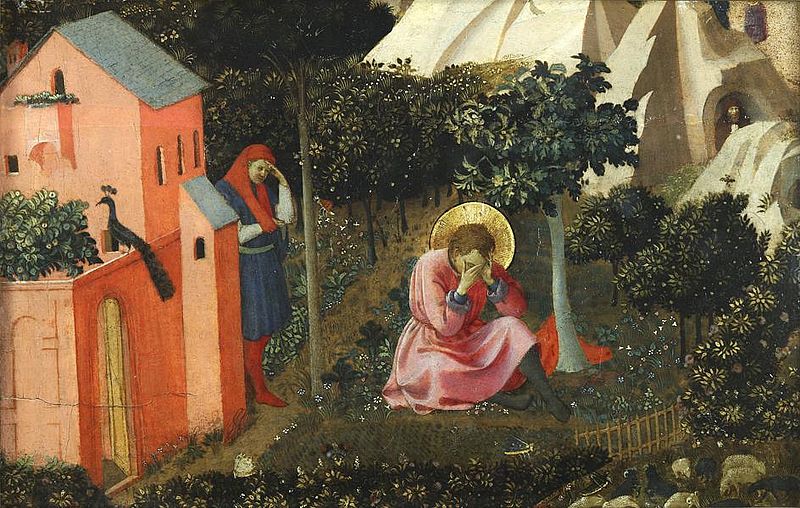
Confessions is one of those monumental works I feel unqualified to review. I read it with as much care as I give any book, especially a nonfiction work, but reading anything written before the 1800s feels like stepping into another galaxy. I don’t feel like I quite belong there or understand everything I see. However, I’ll take a stab at it—consider this my first impressions.
Augustine of Hippo (354–430) is one of the most celebrated and quoted figures in Christian history. His significant contributions to Christian thought appear in such works as The City of God and On the Trinity. He chronicled his transformation from a “prodigal son”-like rebel to a theologian and saint in his Confessions, which he wrote as a middle-aged man looking back on his youth. After his conversion, Augustine lived a long monastic life as a priest and (later) bishop. He was officially recognized as a saint by the Catholic Church in the late 13th century, although his legacy had by that time been already established.
The first thing to know about Augustine as a person was he was very educated and interested in philosophy. Confessions makes many references to the neoplatonism of his youth, specifically the works of Plotinus, and how these beliefs interacted (or overlapped) with Augustine’s understanding of Christianity and Scripture. The footnotes in the Oxford World Classics edition are very handy, though there will still be much that goes over your head. If you can, buddy-read this with someone who is acquainted with philosophy. I very much enjoyed listening to my boyfriend discuss these sections, because he was able to pick up on references that I missed. 🙂 Nonetheless, even with my limited understanding, I could appreciate what Augustine was doing in this book and how important it would have been for the time he lived in.
Along similar lines, we find a lot of references to Manichean beliefs, which, in spite of his Christian upbringing, was Augustine’s first religion he took seriously. These sections of the book hold more historic interest than modern application. What’s more interesting than the details is the process by which Augustine grappled with his beliefs vs those of his mother Monica. He was constantly searching for answers and evaluating contradictions and critiques of both belief systems. It was this ongoing process that led him further and further away from Manichean teachers and towards a Christian bishop named Ambrose, a precursor to his eventful conversion.
This may sound like dry reading, but the first 2/3 or so of the book is actually quite eventful. We follow Augustine from birth (and his interesting view on babies) through his hedonistic youth and up to his time as a teacher in Rome and Milan. In popular references to the saint, much is made of his relationship with his concubine, with whom he lived for 14 years and had a son. But the woman is never named, the relationship glossed over as if it was merely another incident in his struggle with lust. More detail is given to describe various friendships he valued, the trials of teaching rowdy students, and even a comic incident involving a friend who is accused of a crime.
The now-historic details in the book were some of the sections I found most interesting. As in Seneca’s letters, we get a first-hand indication of how gruesome the gladiator games were, yet how easy it was to get caught up in the crowd. Also unsettling are descriptions (sometimes indirect ones) of how slaves and women were treated. There were other details I found surprising, such as children’s baptism being deferred. Not all of the cultural elements have aged badly—his parents’ emphasis on academics and worldly success felt pretty modern. This book demonstrates in so many ways how some things change drastically throughout history and others never do.
The last third of the book is a philosophical ramble that becomes more difficult to untangle as it goes on. I had been warned by three different people it was tough… I can genuinely say I barely understood the last chapter at all. It is worth powering through these sections to get a feel for Augustine’s view on Genesis and how he approached Scriptural interpretation in general. But the last chapter is a fever dream, as far as I’m concerned!
My favorite thing about Confessions—and the thing that gave me a bit of a lifeline to hold onto through the tough parts—is its beauty. In this act of confession, Augustine profusely and poetically shares his personal shame as well as his adoration of God in many lovely passages. Sometimes he is talking to himself, sometimes to the reader, but most often to God. There are lines that make wonderful prayers in themselves.
Here is one I had marked (there are many more). This is from the Henry Chadwick translation (1991):
My weight is my love. Wherever I am carried, my love is carrying me. By your gift we are set on fire and carried upwards: we grow red hot and ascend. We climb ‘the ascents in our heart’ and ‘sing the song of steps’. Lit by your fire, your good fire, we grow red hot and ascend, as we move upwards ‘to the peace of Jerusalem’. ‘For I was glad when they said to me, let us go to the house of the Lord’. There we will be brought to our place by a good will, so that we want nothing but to stay there for ever.


 Classics Considered
Leave a reply to Kafka’s Blue Octavo Notebooks – Classics Considered Cancel reply