
It’s been nearly a year now since I read Claire-Louise Bennett’s first novel, Pond (2015). I know it will become one of those core reading memories, because I remember reading it in my boyfriend’s apartment on a warm July afternoon.
There were traces of Bennett in the reading experience itself. I was infinitely happy that month but also a little depressed and had recently got over a strange stomach ache. My time in his city was rapidly approaching its end. I was doing the kind of math you do in long-distance relationships, i.e. trying to figure out exactly how much time we had left together. There was a lot of time spent in getting to each other every day, since we were staying in separate places. The hours after he finished work were very important, and I became a bit too anxious about optimizing every decision that could afford us more time.
A befuddled blend of cozy contentment, verbose anxiety, and a touch of romanticism was exactly what I found in Pond. It was both familiar and a welcome distraction. Bennett’s slice-of-life vignettes about a quirky woman living alone appealed to me immediately, even as I was hopeful I might not be a quirky woman living alone much longer. As little as was revealed about the narrator, one felt that she had been through times of setbacks and solitude while maintaining a cool head and sense of humor (something I always strive for).
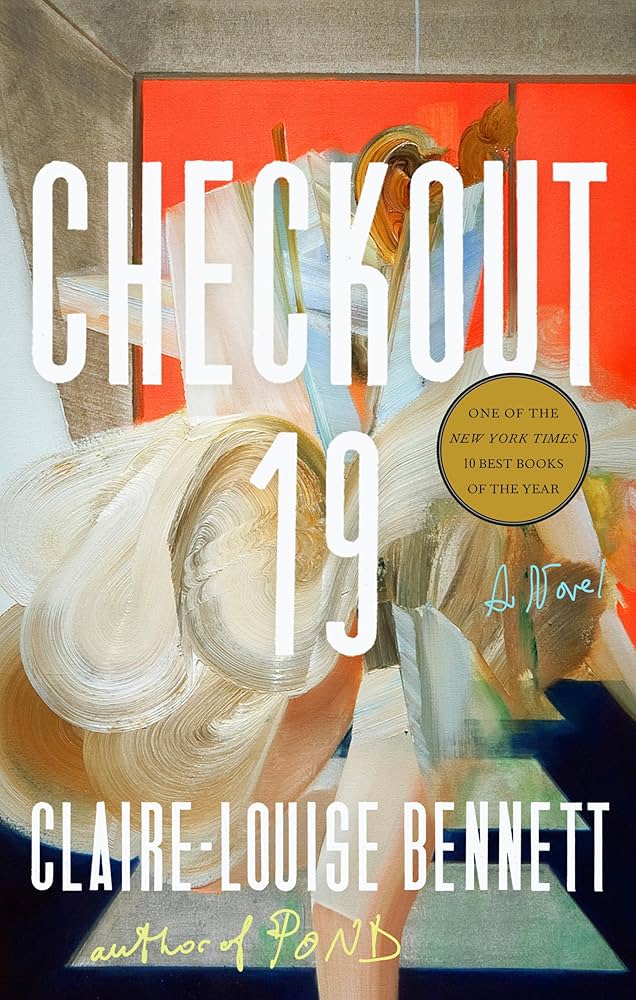
Checkout 19 is a very different book from Pond, yet weirdly still relatable. Broadly speaking, it’s a series of memories about life and books, but that is completely insufficient as a description. We start with the narrator’s schoolgirl memories, which morph into an expression of her life and experience with reading and writing, which takes us into one of her character’s stories (unpublished—and yet, published), which finally leads us to an exploration of her romantic relationships, questionable obsessions, and two traumatic events in her young adulthood.
This is a very mundane summary of a magnificent book. And sadly, I’m reluctant to recommend Checkout 19 to anyone I know, because it is so idiosyncratic, rambling, and a bit disturbing. All I can say is it appealed to me personally and deeply. It wasn’t just that I could relate to the narrator more than I’d care to admit. The writing itself was breathtaking. It was raw, stream-of-consciousness in some places, but also clear and nimble in how it centered around certain themes and connected various threads. If I were to sit down and try to write like this, I would lose those threads and go in circles to no end. Bennett manages—how, I’m still not sure—to seem to go in spaghetti loops, but those iterations make up bigger patterns that point back to earlier chapters. In a way, it is a coming-of-age novel, one that actually feels like grappling with your youth.
That’s not to say that Checkout 19 is without flaws. I wanted to give it 5 out of 5 stars instead of 4, but I couldn’t help but feel that it was maybe 100 pages too long. Not consecutively, but cumulatively. Pond (which I also gave 4, though for different reasons) was a neat little 145 pages. Checkout 19 is more ambitious in scope but still doesn’t quite feel warranted to be 288 pages. The especially good parts happen in a flash, and the well-cultivated, building tension of the other parts felt sometimes just a little too belabored.
This matters more than it should, because it is 2025 and I am a busy human (more than usual right now) and every page must earn its place in my hours of the day. I try not to skim, I have developed an aversion to skimming. Especially with Checkout 19, you don’t know what you might miss. The details that tie each section of the book together are missed if you blink.
The transient quality of things seems to be an understated theme. In the middle of the book, the narrator spends a long time reminiscing about one of her old fictional characters, Tarquin Superbus. Tarquin has acquired a large personal library and is on the hunt for one sentence he can never seem to find, a sentence which is basically supposed to convey the Meaning of Life. He eventually loses patience for this (this is not much of a spoiler), and that leads to some dire consequences in the wider world (definitely a spoiler, so I won’t say what they are). What is perhaps most unsettling is that all of this happens quickly and irrevocably. Much time was spent on describing Tarquin and his life—but Tarquin and his decisions? Sometimes we do make hasty decisions that spiral away from our control.
In none of this is there the sense that the narrator has lost control, at least not intellectually. Towards the end of the book, she shocks us once with a memory, and then again with another one bad memory loosely tied to the first. I use the word “shock” in the purest meaning of the word, because there is nothing in this writing that suggests shock value. If anything, the two events have been related in the most understated way you can imagine. I think this is why they left an impression, because I was left thinking about the narrator and her grip on the situation, not the fear and powerlessness she felt in those moments. But they were not described in an egotistical way; rather, the strength came from its matter-of-factness.
While Checkout 19 lacks some of the charm and emotional safety of Pond, it goes farther in what it means to say, even if I haven’t fully worked out everything it’s saying. It seems like a much more personal novel, and I hope to find some interviews that explain how much of it is nonfiction. It is one of those books I will always look back on as a favorite and a masterpiece, even if my reading experience (scrambling between digital and paperback during a hectic season) has been less than favorable. I really look forward to her third novel Big Kiss, Bye-Bye, which comes out this October.


 Classics Considered
Leave a reply to Marian Cancel reply