
- The Swan: Finding Rilke
- The Castle: Formation of a Masterwork
- The Cross: Rilke and Kierkegaard
- The Grieving: Rest in Acceptance
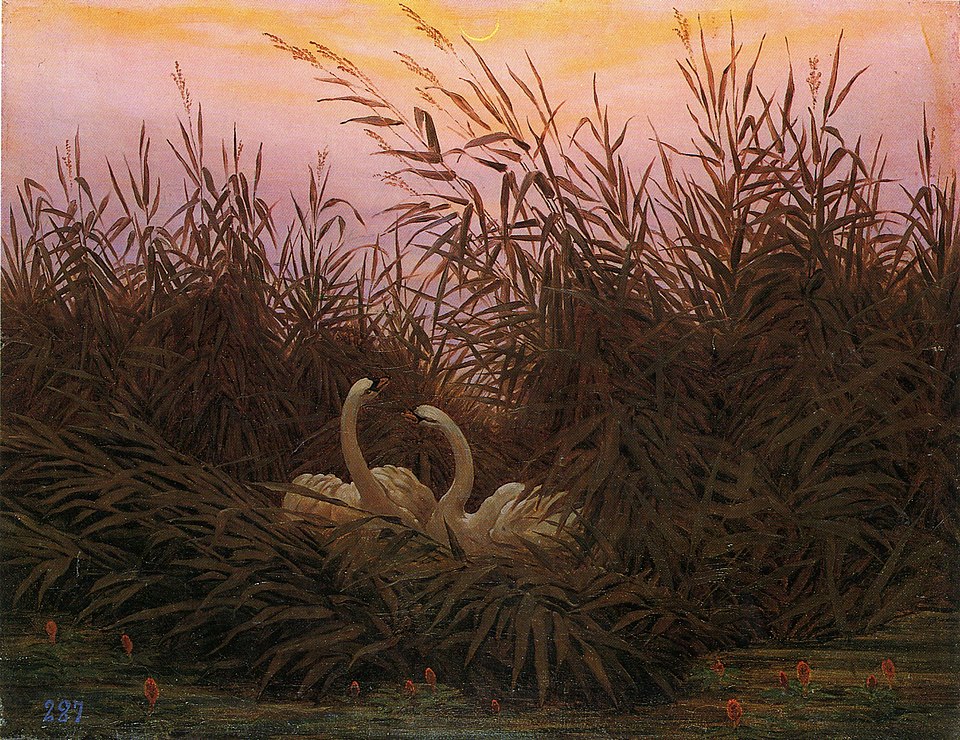
The Swan: Finding Rilke
In this year of personal joy and public tragedy, a little poem called “The Swan” crossed my path. The Austrian poet Rainier Maria Rilke was not unknown to me by name, but it was the first time I had read anything of his. Geoffrey Lehmann’s translation (to be released in a few days’ time) begins:
Our uncompleted lives, this struggling on,
relentless, as though our limbs have all been bound,
is like the awkward waddle of the swan.
Swans are stately creatures, much larger than you would think from pictures, and even more beautiful in person. Rilke’s short poem about death as personified by a swan stepping into the water moved me deeply. The cadence and vowels of Lehmann’s translation seemed to embody this gentle transition, with feelings of sorrow and peace overlapping each other like waves in the pond.
The Castle: Formation of a Masterwork
Too impatient to wait for the release of Lehmann’s book, I picked up a collection of Rilke’s poems from Oxford World Classics (transl. Susan Ranson and Marielle Sutherland). It turned out to be a good choice, because it contains selections from every period of his writing, including some complete works, such as the Duino Elegies.
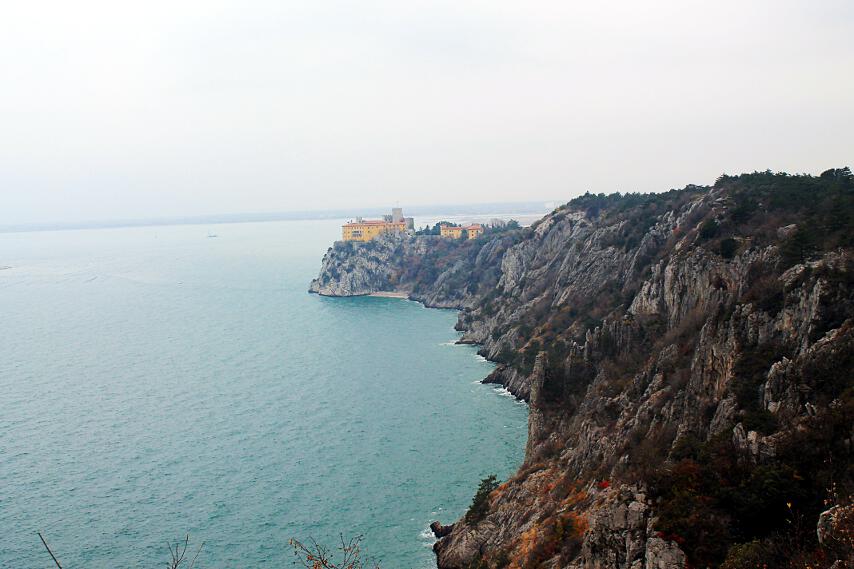
Rilke commenced the Elegies when he was staying at Duino Castle on the rocky, wooded coastline of Italy. Considered one of his masterpieces, this collection of 10 poems was begun in 1912 at the castle, yet only completed a decade later after he learned of the death of a friend’s 19 year-old daughter.
… And you too, all
who loved me for my slight incipient love—
a love for you I always turned away from,
because the space I saw within your faces
changed when I loved it into cosmic space,
where you no longer were…
—Fourth Elegy
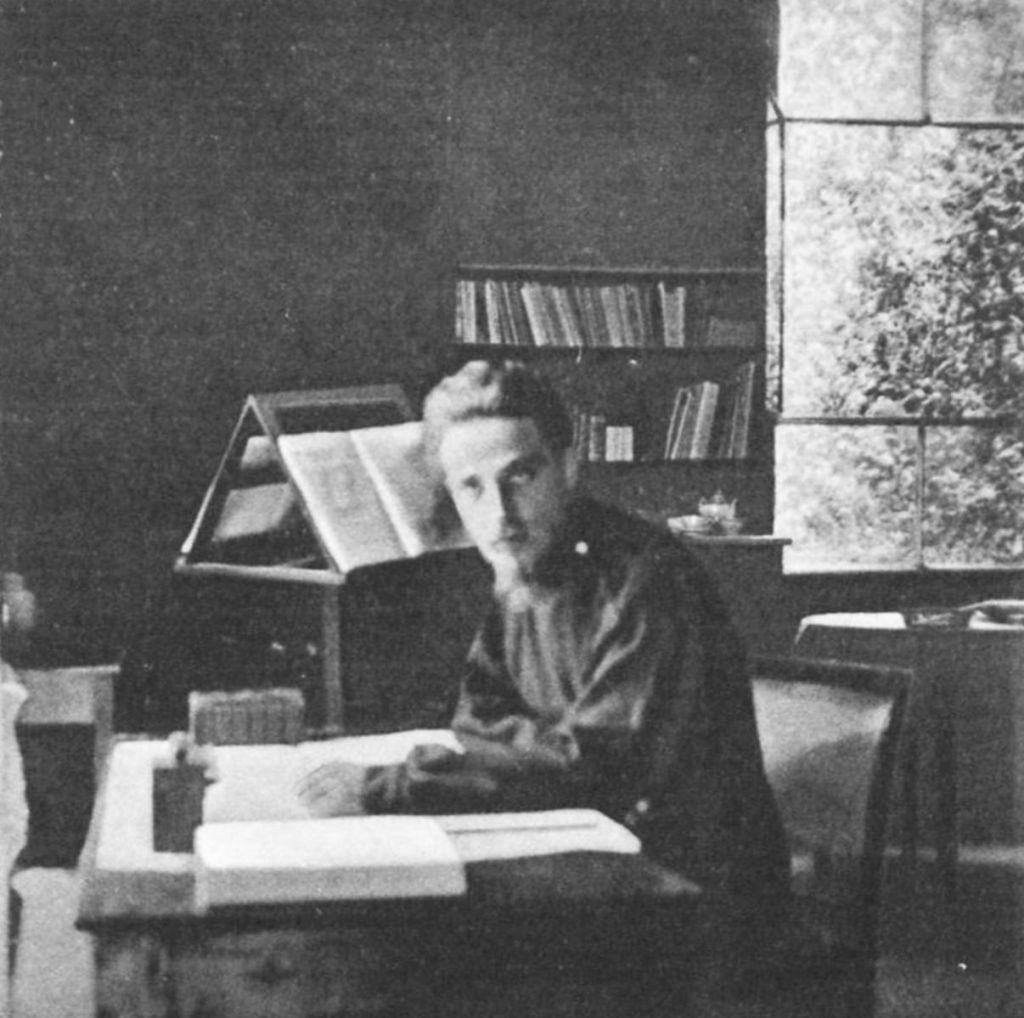
Rilke’s life was marked by alienation and sadness from a young age. In the Duino Elegies, these experiences are conveyed in cosmic yearnings on love, loss, and spiritual transcendence. In this midst of these complex themes, I found the Elegies can be read in at least three ways:
- A surface-level, meditative reading, in which one simply absorbs the words and emotions on the page. This can be difficult in translation, but with a good translation, perfectly feasible.
- An analytical, literary reading. After realizing that Rilke writes in a taxonomy of his own, I prefaced each elegy by reading all the endnotes for it first, which opened up for me the meaning of various words and literary references.
- A philosophical reading. Much like the previous reading, if one focuses mainly on the meaning of the text, some (much cleverer people than me) can begin to formulate a systematic understanding of Rilke’s philosophical and metaphysical ideas.
The Cross: Rilke and Kierkegaard
What about a religious reading? I did find myself drawn towards a religious interpretation of the Elegies, although in the full consciousness that this is unlikely to be in accordance with Rilke’s intent. To be sure, his poetry is most certainly spiritual, but he was careful to distinguish between the vocabulary of established religions versus the meaning he ascribed to certain words.
For example, “angels” are referred to throughout the Elegies, but it would be a mistake to think of them as biblical angels. In the endnotes, Rilke is quoted from a 1925 letter to his Polish translator as saying that his Angels are not Christian angels and not quite Islamic angels (though inspired by the latter). They are, as editor Robert Vilain puts it: “…transcendent beings of perfect consciousness, beyond time, beyond the limitations of physicality, representations of the most intense beauty.” In Rilke’s own words:
The Angel of the Elegies is that being which guarantees the recognition of a higher degree of reality in the realm of the invisible.—It is therefore “terrible” to us because we, who love and transform it, still cling to the visible.”
If this all seems a bit esoteric and perhaps far removed from the sensibilities of everyday life, never mind Christianity—I could hardly disagree. But this is where reading is, to some extent, in the eyes of the reader, insofar as our own perceptions and experiences help to transform the conveyed meaning of a text, especially one so mysterious as the Duino Elegies.
Death is a core theme in Christianity, not only the reality of death (physical and spiritual) and particular deaths (Adam and Christ), but how we are to approach and understand our own mortality. For the Christian on the narrow path, dying is merely a transition, transporting us from the material world to the spiritual world to await resurrection—both of spirit and body—and reunion with God. In His humiliation, torture, and execution, Christ took the weight of the world’s evil upon Himself, so that “all that believe in Him should not perish, but have everlasting life”.1 Death becomes, then, nothing to fear; it is another beginning, not an ending.
Rilke’s writing is consonant with the Christian notion of death as something to be reconciled with, even embraced. In his view, however, this was not something taught by the church of his time. In a 1923 letter (p. 315), he wrote:
I reproach all modern religions with the fact that they have offered their faithful consolations and palliatives for death rather than giving their minds the means of living with it and coming to terms with it
I am unfamiliar with the Catholicism of Austria in the 1920s, but I can well imagine why he found some commonality with Søren Kierkegaard, the Danish philosopher who was (about 80 years earlier) also critical of the state church. Kierkegaard, who had lost most of his immediate family by age 25, did not find his life’s purpose in 19th-century Christendom as he experienced it. In the view of German-Canadian professor Clive Cardinal, whose 1969 essay contrasts the two figures, both men were preoccupied with “the affirmation of a fundamental decision and man’s confrontation with dread.”2 This essential conflict, encountered in isolation, likewise was confronted and grappled with in solitude.
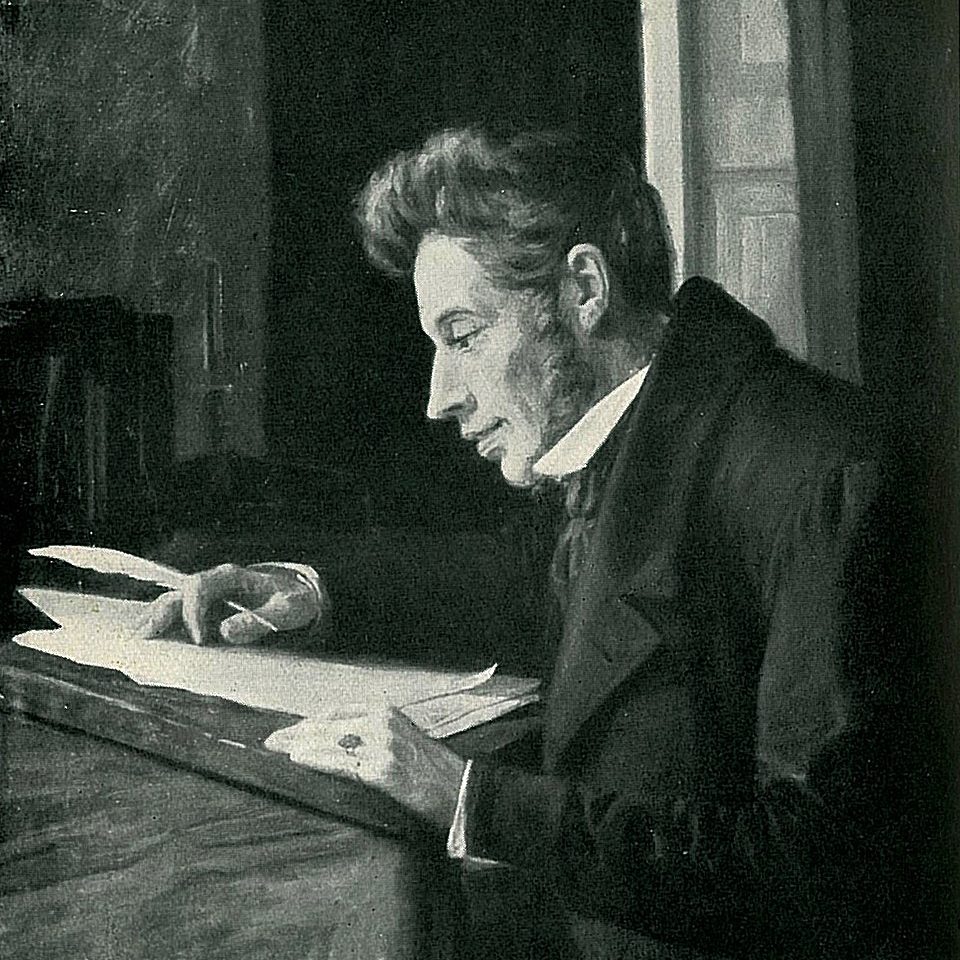
But their commonality ends with their different approaches to the problem of dread. Cardinal describes Kierkegaard’s insistence on making a personal choice (his Either/Or), ultimately leading to “the leap” by faith and towards God. This finds its stark counterpoint in Rilke’s outlook, which is an endless openness to aesthetic experience—a “multiplicity” of choices—“a poetic conjuring in which the interrogation is more significant than the answer given” (Cardinal, p. 4).
In his ninth Elegy, Rilke writes enigmatically:
Earth, is it not just this that you want: to arise
invisible in us? Is not your dream
to be one day invisible? Earth! invisible!
What is your urgent command, if not transformation?
Earth, you darling, I will! …
Beyond all names I am yours, and have been for ages.
You were always right, and your holiest inspiration
is death, that friendly death.
In his embrace of and surrender to the cosmos, Rilke suggests a ceding of the Self, whereas Kirkegaard pushes beyond the aesthetic, in seeking relationship with God in the being and moral autonomy of the individual. This holds practical implications for those struggling with grief and loss: suffering is universal, but the experience of suffering is unique. As Holocaust survivor Viktor Frankl put it:
. . . no human suffering can be compared to anyone else’s because it is part of the nature of suffering that it is the suffering of a particular person, that it is his or her own suffering—that its “magnitude” is dependent solely on the sufferer . . . a person’s solitary suffering is just as unique and individual as is every person.3
For the Christian, there is infinite consolation found in an individual’s unity with the Creator through Christ, in whom the allure of the natural world finds its origin (and someday, its complete restoration).
The Grieving: Rest in Acceptance
As with “The Swan,” I was profoundly moved by these poems, despite being sometimes at a loss to understand them. At the heart of the Elegies are some very basic human feelings: loneliness, grief for lost love (or loved ones), and the feeling that something grand and beautiful is always a bit out of reach. Woven into this poetic narrative is a growing acceptance of our mortality.
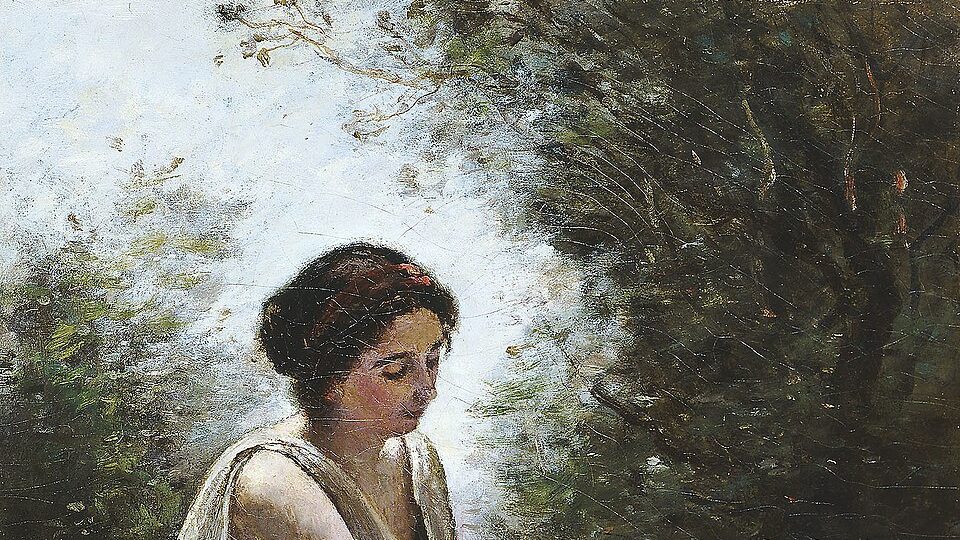
In the tenth Elegy, a wandering, ghostly woman—reminiscent of Eurydice or of Dante’s Beatrice— leads a young man through the landscape of Grieving, a magnificent ruin of towers, flowers, and kingdoms under the stars. Grieving is made beautiful in remembrance of the life that came before, but also in reconciliation with death as a part of life. This juxtaposition of spectacle and sadness culminates in Rilke’s final, heartrending stanza, where “…we, thinking of happiness rising, would find our emotion almost bewildering us, seeing a happiness fall.”
In the Duino Elegies, Rilke creates a somber space for those in mourning, to lose ourselves in contemplation of a Picasso painting or a fig tree, and even to weep. A Christian may find divine comfort in this, for “every good gift and every perfect gift is from above, and comes down from the Father of lights, with whom there is no variation or shadow of turning”.4 Enduring all things and with such gifts given to us, we can look forward to the next world, when death itself has died and we will finally be free in every aspect of our being.
- John 3:16 ↩︎
- Cardinal, C. H. (1969). Rilke and Kierkegaard: Some Relationships between Poet and Theologian. The Bulletin of the Rocky Mountain Modern Language Association, 23(1), 34–39. https://doi.org/10.2307/1346580 ↩︎
- Frankl, V. E., Goleman, D., & Franz Vesely. (2020). Yes to life : in spite of everything. Beacon Press. ↩︎
- James 1:17 ↩︎


 Classics Considered

Leave a reply to Lory Cancel reply