
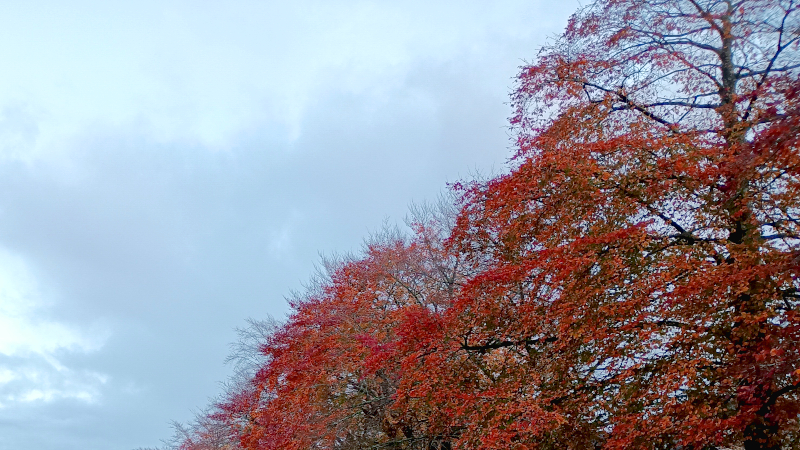
I’ve experienced all other seasons in the UK before, but this is my first autumn. It is much like a Pacific Northwest fall—instead of a sharp change from summer to winter, summer fades very slowly, giving autumn plenty of time to look around before making itself at home. Bright greens fade to pastel yellows, then deepen into the most brilliant orange and copper leaves. The ground is covered in wet leaves, and sunsets brim with moody clouds.
There’s been lots of nights of fireworks, first for Diwali and then for Bonfire Night last week. I am thinking wistfully about Thanksgiving dinner and how I might create some version of it here. But even as the season draws to an end, the stores are stocked with fun and different Christmas treats, and the mall (shopping centre) is cheerfully decorated. I’m very excited to spend my first Christmas with Mr H. ❤
In Sickness and in Health
One thing about moving to a new country I had not expected was getting sick so often. In the US, I rarely got ill, once a year at most. But in just four months, I’ve had three bugs, one of which must have been a flu or COVID. I’ve made it 2-3 weeks now without any illness and have started taking vitamins daily. My experience with healthcare has been good at least—having paid the Immigration Health Surcharge, I’ve found it very easy to get doctor’s visits, referrals, and prescriptions.
It has been a time of ups and downs and lots of stress, as I get acclimated and try to find a new job. I am much happier than I was in the US, but that’s not to say I haven’t had my share of bad days and meltdowns. And one has to make a conscious choice to leave behind old worries for a fresh start to really be fresh. How to stay connected with a past life without letting it ru(i)n the present is something I’m still learning. Both immigration and marriage require some intentionality in this area—being single for so long can have as much influence on one’s mentality, and identity, as being American. Chronic nostalgia is no good in this situation.
The Ruthlessness of the Past
I remember my Bulgarian history professor warning against nostalgia and the need to nip it in the bud before it causes “permanent damage.” I don’t know if he truly succeeded in this, but the lesson has stuck with me.
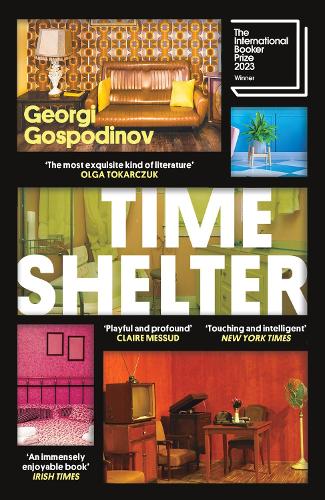
In the novel Time Shelter by Georgi Gospodinov, which I’m reading for Reading the World, the refugee Mr. S. (with a very similar backstory to my professor) inspires a revelation in the narrator about nostalgia. The narrator writes:
…clearly, in order to survive there, in a new place, you had to cut off the past and to throw it to the dogs. (I could never do that.) To be merciless toward the past. Because the past itself is merciless.
Cutting off the past is never so simple, of course, as it will always find ways to pop up and surprise you. I understand the idea behind this, however.
The characters of To the Lighthouse by Virginia Woolf could learn a thing or two from this. Mr and Mrs Ramsay, the glittering middle-aged couple at the heart of the family, seem to have everything together, and yet in their own ways, they are stuck in the past. Their need to control others stems from insecurities rooted in their youthful glory and how they are self-conscious of their own fading. What was once brilliant and alluring in Mr Ramsay’s pride has become a lot of rough edges and tyrannical behavior, while Mrs Ramsay plays at matchmaker and entertaining young men.
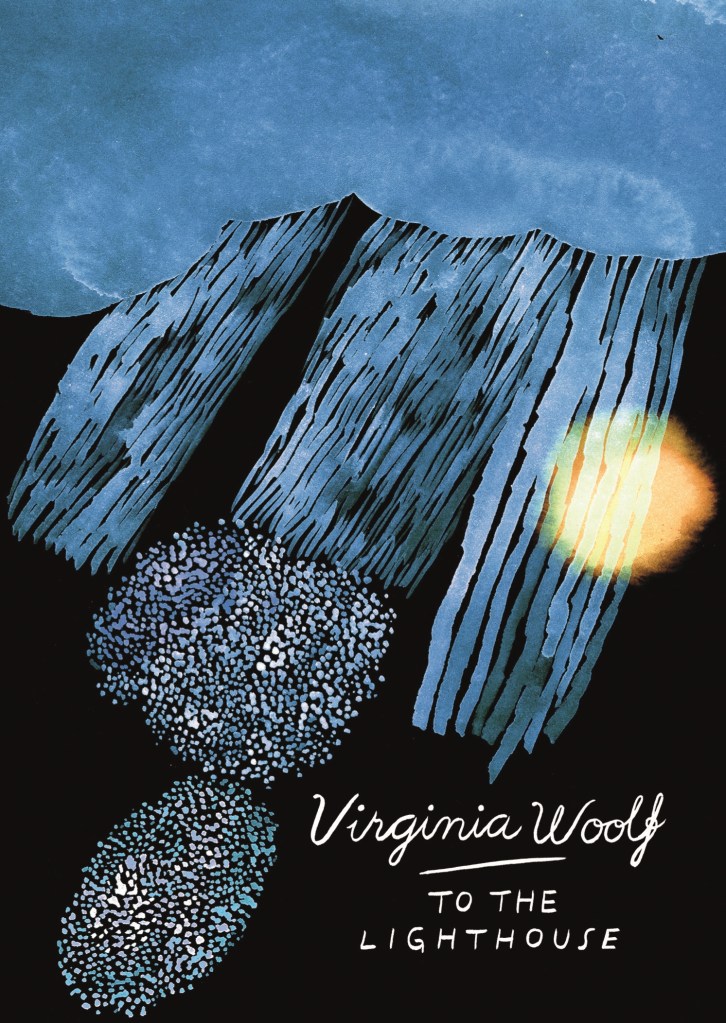
Mr H and I have been reading this one at our own paces (it is a reread for him), and I recently finished it. I think it is a genius novel, maybe not quite as captivating as The Waves but more accessible and in some ways more creative. I have rarely read a book that more perfectly expresses how people think and act, within themselves and with each other and influenced by their surroundings. As such, however, it is oppressive (how could it not be?), because it is so rich.
A Tale of Two Claires
Apart from Woolf, I had started reading Big Kiss, Bye-Bye by Claire-Louise Bennett, a book which Mr H surprised me with on its publication date. Impressed and charmed by Pond and Checkout 19, I was so looking forward to this new Bennett novel which promised to be more focused on people and relationships. Finding out that it is mainly about a love affair between a young woman and a grandfather-aged man really dampened my enthusiasm. It’s 2025—is there really anything new or interesting to say about this kind of relationship? The relationship here is not some kind of progressive December-May romance… it’s simply another story of power imbalance, vulnerability, and codependency. There has also been a sex scene that compelled me to skip some pages, and I haven’t felt inspired to pick up the book since. I think I will finish it, but in the words of Goodreads reviewer Jen: “this book felt like catching up with a friend, who won’t stop texting their ex.”
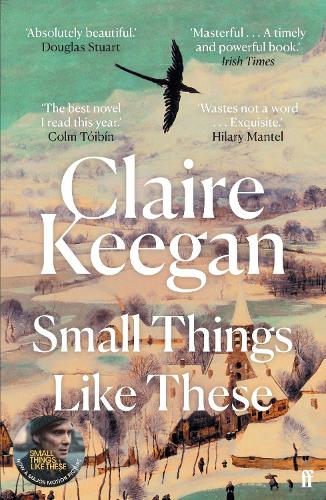
A novella I recently finished that was more to my liking was Small Things Like These by Claire Keegan. Keegan is an Irish author, and this novella was adapted last year in a film starring Cillian Murphy (which I have not seen yet but is on my watchlist). Small Things Like These is a Christmas story about a man who is working to provide stability for his family, only to be confronted by a moral dilemma that could alter their entire trajectory. I really appreciated the simplicity of the plot, but like others I do wish it had been a bit longer and more developed. The ending was meant to be uplifting, but it left me feeling uneasy for the characters.
Societies, Smaug, and Short-Form Content
In another book club, I’ve just read Shirley Jackson’s “The Lottery” and “The Ones Who Walk Away from Omelas” by Ursula Le Guin. I wasn’t terribly impressed by either of these short stories, in spite of their famousness. Jackson’s felt underdeveloped, and Le Guin’s too preachy. My gold standard for “short story about society becoming apathetic, materialistic, and immoral” is Franz Kafka’s The Metamorphosis, which uses a single family to explore not just the how but the why behind these themes.
On a completely different note—Mr H has been reading The Hobbit by JRR Tolkien to me. We’ve both read or had the story read to us before. I don’t know if it’s my low attention span or what, but I am finding it very slow this time, and so is he. I’ve never been the biggest fan of Tolkien’s writing style, truth be told, but I remember enjoying The Hobbit more in the past.
I wonder if short-form content (i.e. Instagram reels and YouTube shorts) has fried my brain a bit. Where I notice this most is in watching movies. Books have not got too much harder for me to read (thankfully) but I find myself getting bored faster in movies.

For a last bit of “classics considered,” we did go to see del Toro’s Frankenstein in the indie cinema recently. It was good, but… very gory, with only 1-2 scenes being actually scary (this surprised me). I think the first 1-2 scenes of gore were effective and thought-provoking, but the rest of it was gratuitous. I enjoyed the music most of all, which featured a haunting orchestral score with violin solos. The cast was also very good, with Oscar Isaac from Dune 1, Mia Goth from Emma (2020), and even Charles Dance (who has been in countless costume dramas and seemed absolutely fitting as Frankenstein’s father).


 Classics Considered
Leave a reply to Cyberkitten Cancel reply